
The parts of a breathing apparatus
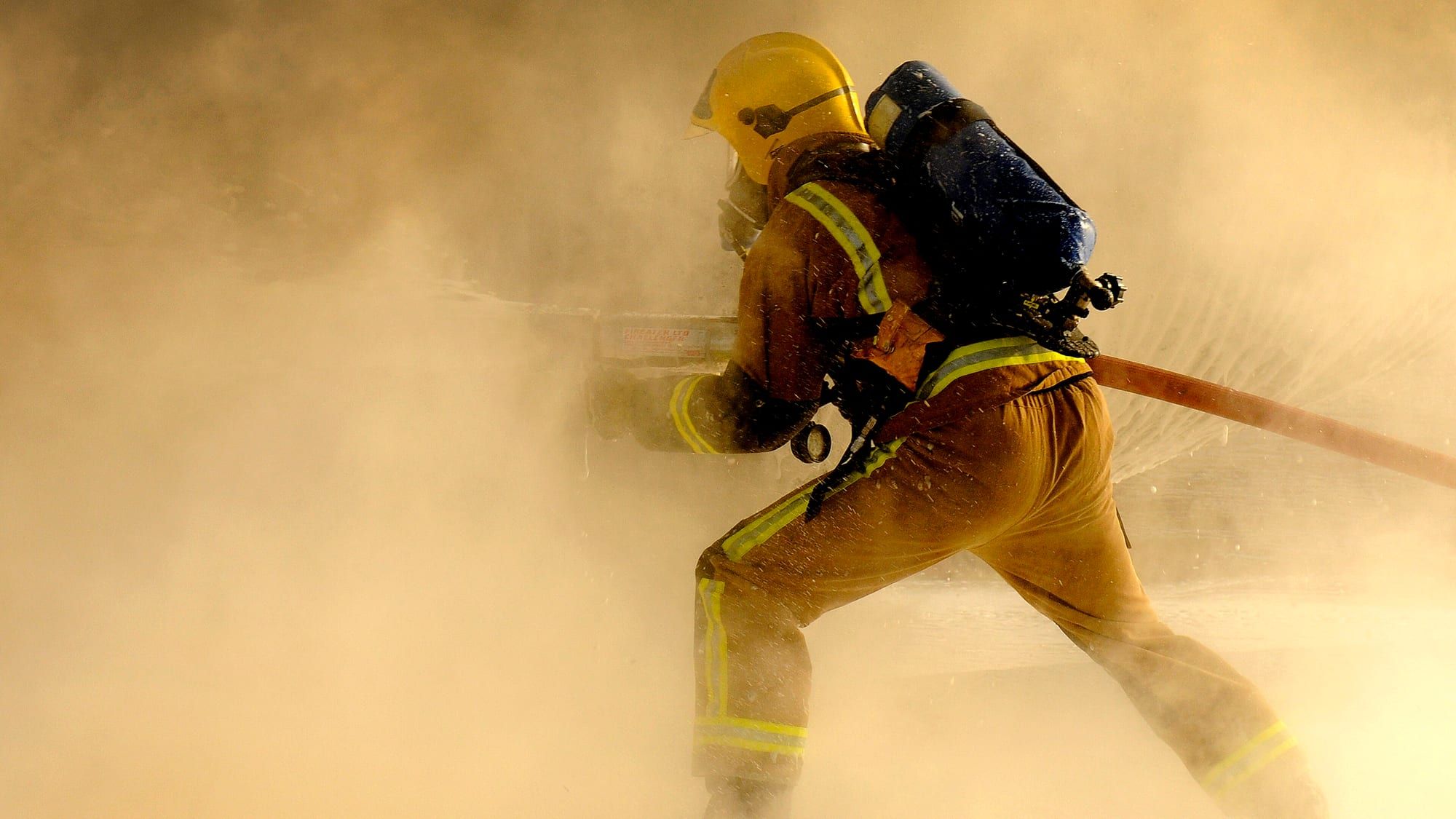

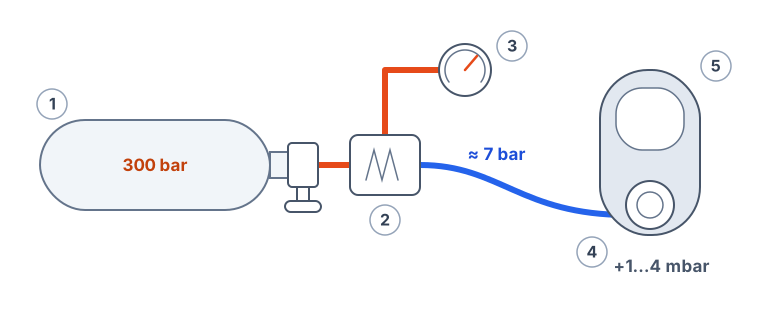
The cylinder of a self-contained breathing apparatus (SCBA) holds ordinary compressed air, not oxygen, at up to 300 bar. The air enters the facepiece a few millibar above ambient pressure. Between the cylinder and the facepiece are two valves that bring the pressure down, some hose, a pressure gauge and a whistle. This is a walk along that path, part by part, and a calculation of how much air the cylinder really holds.
Three pressure zones
A firefighter’s breathing apparatus is open-circuit. Exhaled air does not return to the system but leaves through the exhalation valve. On its way from the cylinder to the face the air passes through three pressure zones.
| Zone | Pressure | Where |
|---|---|---|
| High pressure | 200 or 300 bar (about 2,900 or 4,350 psi) | cylinder, cylinder valve, line to the pressure gauge |
| Medium pressure | about 7 bar (about 100 psi) | hose from the pressure reducer to the demand valve |
| Low pressure | a few millibar above ambient | facepiece |
The high-pressure parts stay on the back. The hose that runs over the shoulder to the facepiece carries only medium pressure.
The cylinder
Cylinders are steel or composite, with an aluminium liner wrapped in carbon fibre. An empty 6 litre steel cylinder weighs about 8.5 kg, a 6.8 litre composite one about 4 kg.
The amount of air is found by multiplying the cylinder’s volume by its pressure, but that only holds up to about 200 bar. At 300 bar air compresses less than this sum predicts, so the cylinder holds about 10% less. A 6.8 litre cylinder at 300 bar does not contain 2,040 litres of air but about 1,840.
The cylinder valve is opened fully for use. Some valves have an excess-flow device that limits the outflow to about 600 litres per minute if the valve breaks off, so the cylinder does not take off.
A cylinder should not be emptied completely. Moisture gets into an empty cylinder, and moisture freezes in the valves when the air cools sharply as it expands. For the same reason the air used to fill cylinders has to be very dry.
The pressure reducer
The pressure reducer, also called the first stage, brings cylinder pressure down to medium pressure, usually about 7 bar. Inside are a piston and a spring. When the wearer inhales, medium pressure drops, the spring moves the piston and air flows from the cylinder. When the pressure rises again, the piston closes the passage. This repeats with every breath.
A relief valve sits on the medium-pressure side. If the reducer fails and medium pressure rises, the relief valve vents the excess. Depending on the design it opens at 11 to 14 bar. The wearer can still breathe, but the apparatus is faulty and they should leave at once.
Two lines leave the reducer: a high-pressure line to the pressure gauge and a medium-pressure hose to the demand valve. Many sets also have a second medium-pressure connection for another person’s demand valve.
The demand valve and positive pressure
The demand valve, called the second-stage regulator in North America, supplies air only while the wearer inhales. Inside is a diaphragm that opens a valve through a lever. In the older design the valve is opened by the suction of the breath. Pressure in the facepiece is then below ambient at every inhalation, so smoke enters through any gap at the seal.
Today’s firefighting sets are positive-pressure. An extra spring loads the diaphragm, so the valve closes only when pressure in the facepiece is 1 to 4 millibar above ambient. The exhalation valve has its own spring and opens at a slightly higher pressure, because otherwise air would flow out all the time. If the facepiece leaks somewhere, air goes out and smoke does not come in.
Positive pressure is not constant flow, because the valve closes at every exhalation. Nor does it replace the seal. Regulations do not allow a beard or sideburns at the edge of the facepiece even with positive pressure, and air that escapes past the seal is air that is no longer in the cylinder.
The demand valve has to be able to deliver far more air than the wearer uses on average, because inhaling takes up less than half of the breathing cycle. The United States regulation, for example, requires a flow of more than 200 litres per minute.
The facepiece
The facepiece covers the eyes, nose, mouth and chin. It carries the lens, the face seal, the head harness, the speech diaphragm, the exhalation valve and the connection for the demand valve. Inside it is a smaller inner mask, or nose cup, that covers only the nose and mouth.
Inhaled air first sweeps across the lens and only then passes through valves into the inner mask. That keeps the lens from fogging. The inner mask also reduces the space where exhaled air lingers, so the wearer rebreathes less of their own carbon dioxide.
The lens is polycarbonate and is the part of the apparatus that tolerates heat least. In laboratory tests the outer surface of the lens developed fine cracks at about 180 °C (356 °F), bubbles at about 200 °C (392 °F) and holes at about 270 °C (518 °F). Positive pressure drives air out through a hole and the cylinder empties quickly. Cracks or bubbles on a lens after a fire are a sign that the facepiece was close to that limit. A facepiece like that does not go back into service.
The pressure gauge and the low-air alarm
The pressure gauge shows cylinder pressure and is the only reliable information on how much air is left. When pressure falls to a set limit an audible alarm sounds, in most sets a whistle.
The limit depends on the standard. In most of Europe the whistle sounds at about 55 bar, in British practice higher, so that about ten minutes of air remain, and in North America when about a third of the contents is left.
In a 6.8 litre cylinder 55 bar is about 370 litres of air, a fifth of the contents, less than five minutes during hard work. Whoever heads out only when the whistle sounds is making the way back on the emergency reserve.
How long the air lasts
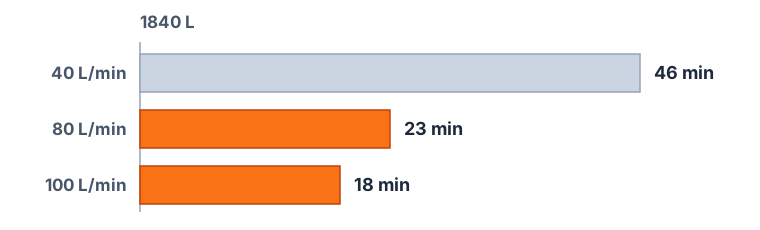
A cylinder’s rated duration is calculated with a breathing rate of 40 to 50 litres per minute. Firefighters at work use much more. In a study of fifteen career firefighters the average during simulated firefighting was 82 litres per minute, and 102 in the hardest task.
| Cylinder at 300 bar | Air in the cylinder | 40 L/min | 80 L/min | 100 L/min |
|---|---|---|---|---|
| 6 L | about 1,620 L | 40 min | 20 min | 16 min |
| 6.8 L | about 1,840 L | 46 min | 23 min | 18 min |
| 9 L | about 2,430 L | 61 min | 30 min | 24 min |
These are minutes to a completely empty cylinder, with no reserve.
In one study firefighters in full gear climbed the stairs of a high-rise building. On a cylinder rated for 30 minutes the first alarm sounded after 8 minutes. In another, individual firefighters used between 26 and 68% of a cylinder for the same task. That is why each wearer reads their own gauge, and why the one who uses the most air sets the working time of the team.
The way back is planned before going in. One widely taught rule is to keep twice as much air for the way back as was used on the way in.
The apparatus is tiring in itself. In measurements, maximal oxygen uptake with the apparatus was about 15% lower than without it. Most of that drop comes from breathing through the demand valve, and less from the load on the back.
The check before use
Before use the apparatus gets a short check. The steps are the same everywhere, the numbers are not.
- Look over the apparatus, the harness and the facepiece.
- Open the cylinder valve and read the pressure.
- Leak test: close the cylinder valve and watch whether the gauge pressure falls.
- Alarm test: release air slowly until the whistle sounds.
- Check the seal of the facepiece on the face.
In central Europe the cylinder usually has to hold at least 90% of its rated pressure, and the pressure may fall by no more than 10 bar in one minute. Elsewhere the limits differ. What applies is the manufacturer’s instructions and the rules that bind the unit.
After every use the facepiece and the demand valve are cleaned and disinfected. They have to be completely dry before storage, because water left in the demand valve freezes just as moisture from the cylinder does.
Sources
- Hessische Landesfeuerwehrschule, Aufbau und Funktion eines Pressluftatmers (2020, in German)
- vfdb guideline 08-40, annex 2: maintenance and testing of breathing apparatus (in German)
- Feuerwehr-Dienstvorschrift 7, Atemschutz (in German)
- 42 CFR Part 84, United States approval of respiratory protective devices
- Operational Guidance: Breathing Apparatus, United Kingdom (2014)
- Luxfer, data sheet for a 6.8 L / 300 bar composite cylinder
- Holmér and Gavhed 2007, air use during firefighting
- Williams-Bell et al. 2010, air use in a high-rise building
- Williams-Bell et al. 2010, air use in a subway system
- Eves et al. 2005, effect of the apparatus on breathing and maximal exercise
- NIST Technical Note 1785, thermal performance of facepiece lenses